> ## Documentation Index
> Fetch the complete documentation index at: https://developer.voyado.com/llms.txt
> Use this file to discover all available pages before exploring further.
# Identification and cookies
> How the tracking script links a website visitor to a contact in Engage, and the cookies it uses to do it.
*Identification* means linking a visitor browsing your website to a specific contact ID in Engage. Until that happens, their activity is stored against their browser instead.
Once a visitor is identified, all their activity from that browser — including the activity recorded **before** they were identified — is connected to their contact record in Engage.
Because anonymous activity is connected retroactively, never restrict `cart()` or `productview()` calls to logged-in or identified visitors. Send events for everyone.
## How a visitor gets identified
The tracking script identifies a visitor in three ways:
1. **They click a link in an Engage email.** The link carries a `vtid` query parameter, which the script reads from the URL.
2. **Your site identifies them and calls `setContactId()`**, for example on login, registration, newsletter signup, completed purchase, or [soft identification](/docs/contacts/identify-contact/soft-identification).
3. **A `_vaI` cookie already exists** from a previous visit.
The identification then applies to all subsequent events from that browser, until the cookie expires or changes (such as when a different person logs into the same browser).
### The order of events
1. The visitor gives consent for cookies. **No cookies are created before this.**
2. Activity in that browser is recorded anonymously against the client ID in the `_va` cookie.
3. The visitor is identified, and their contact ID is stored in the `_vaI` cookie.
4. Engage connects the earlier anonymous activity to that contact.
## The cookies
Both cookies are first-party.
| Cookie | Contains | Example value | Lifespan |
| ------ | ----------------------------------------------------------------------------------------------------------- | ------------------------ | -------- |
| `_va` | The **client ID**, generated by the script. Links all events from that browser together. | `VA671.1135834162` | 1 year |
| `_vaI` | The **contact ID** (guid or shortguid) of an identified contact. Links those events to a contact in Engage. | `a8tPsy8eqUm-yKoeAMPv7Q` | 1 year |
`_vaI` is `_va` followed by an uppercase letter **I** (I as in Ingemar), not a lowercase L.
In Safari, any cookie created with JavaScript lives for a **maximum of 7 days**, regardless of the expiry date set. See [server-side cookies](#server-side-cookies) for the workaround.
### About the vtid parameter
`vtid` holds the contact ID in an encoded form, which Engage decodes internally. An Engage user cannot retrieve the contact ID or identify the contact from the `vtid` value alone.
When you send events, the `contactId` field accepts either the full contact ID guid or the encoded value from `vtid`.
## Using setContactId()
Call `setContactId()` with the visitor's `contactId` at the moment your site identifies them:
```javascript theme={null}
va("setContactId", "contactId");
```
When using soft identification on a site running the tracking script, take the `contactId` from the decrypted `eClub` query parameter.
`setContactId()` does not generate a request to the Collect endpoint.
Never call `setContactId()` with zero, an empty string, `null`, `undefined` or any other invalid value.
A visitor may already be identified without being logged in. For instance, if they arrived from an email link. Calling `setContactId()` with an invalid value clears that existing identification.
Voyado recommends also including `contactId` explicitly in every `cart()` and `productview()` event for identified visitors.
## Server-side cookies
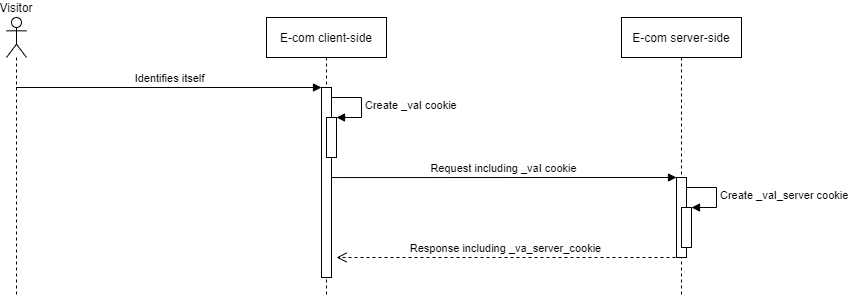
Apple's Intelligent Tracking Prevention (ITP) caps client-side cookies and LocalStorage in Safari at 7 days. Since `_vaI` is created by the script, an identified visitor who doesn't return within 7 days loses their identification.
The cap does not apply to cookies created server-side. Script version 0.1.7 and later can therefore read a server-created cookie named `_vaI_server` and use it to recreate `_vaI`. Identified visitors then stay identified when they return, even after months away.
### How to implement it
Server-side, check whether the incoming request contains a `_vaI` cookie. If it does, copy its value into a new `_vaI_server` cookie with a one-year expiry and add it to the response.
```csharp An example in C# theme={null}
if(HttpContext.Request.Cookies.TryGetValue("_vaI", out var contactId) && !string.IsNullOrWhiteSpace(contactId) && contactId != "undefined")
{
var option = new CookieOptions
{
Expires = DateTimeOffset.Now.AddYears(1),
HttpOnly = false
};
HttpContext.Response.Cookies.Append("_vaI_server", contactId, option);
}
```
 ### When \_vaI is recreated
The script recreates the `_vaI` cookie in any of these cases, checked in this order:
1. Your site calls `setContactId()`, or includes `contactId` in an event.
2. The URL contains a `vtid` parameter.
3. LocalStorage contains a `vtid` key.
4. A `_vaI_server` cookie exists.
### When \_vaI is recreated
The script recreates the `_vaI` cookie in any of these cases, checked in this order:
1. Your site calls `setContactId()`, or includes `contactId` in an event.
2. The URL contains a `vtid` parameter.
3. LocalStorage contains a `vtid` key.
4. A `_vaI_server` cookie exists.