

Transactions
The fields are as follows:string
required
A value to match against the specified
matchKeyType and contactType. If a transaction is submitted with a contact match key that does not exist in the system, that transaction will be skipped and not imported.string
required
What the
matchKeyType value represents. Options are: contactId, memberNumber, socialSecurityNumber, mobilePhone, externalId, email.string
If used, matching will only be done for this contactType. If NOT used the default value will be “Member”.
string
required
If a transaction already exists with this
uniqueReceiptId the new transaction with the same value will be seen as a duplicate and ignored.datetime
required
Datetime when order was first created formatted according to ISO 8601. Example: 2017-09-06T15:55:54+01:00.
string
required
The external id for the store (usually a numerical code).
currency
required
The currency code according to ISO 4217 for the currency that the customer paid in (local currency). Example: NOK, SEK, EUR.
decimal
required
The total price paid by the customer including VAT. A decimal point (.) is always used as decimal separator. If the transaction is of type RETURN then
totalGrossPrice should be negative.rows
required
All payment methods used in this transaction.
rows
required
One row per line item in the transaction.
string
required
The transaction number, does not need to be unique.
decimal
Currency values for a transaction should be in the local currency. This multiplier is used to convert those to a group currency when storing them for segmentation and reporting. Omitting this will cause problems.
rows
One row per used reward voucher.
rows
One row per used promotion.
exchangeRateToGroupCurrency is not mandatory, it’s recommended in order to ensure that currency conversions are correct. If no exchange rate is sent, Customer Engagement will use the fallback conversion set up in the back-end.
If contact.matchKeyType is set to contactId, then contact.contactType is not a required field. In this case, if the value is not given, Customer Engagement will just use whatever your default contact type is.
paymentMethods[row]
string
required
A string, for example: “card”, “cash”, “creditcard”, “swish”, “klarna” (max 245 characters).
decimal
required
Amount as a decimal. This can’t be empty.
string
Descriptive text (max 255 characters).
array
Additional data regarding the specific payment method. This field is accepted in the request but is not stored, processed, or available for segmentation in Customer Engagement. If you need to act on or segment by this information, contact your Voyado team so they can advise on the best approach.
items[row]
string
required
A line item can either be a PURCHASE, a RETURN or an ADJUSTMENT.
string
required
Stock keeping unit.
string
required
Can be the same as the SKU.
string
required
The name.
integer
required
Number of units sold in this line item. Must be negative for a return.
decimal
required
The paid price including VAT for this line item. Note: always withdraw discount values for the item itself or the distributed discount value for a total discount. Read more under Discounts.
decimal
required
The VAT paid for this line item.
decimal
required
The VAT (moms) percentage for this line item.
string
The group.
decimal
The margin in percent on this order line. Can’t be empty or negative. Note that your Customer Engagement instance needs to be activated for searching on margins. Please contact your Voyado team for configuration requests.
bool
Flag that controls if the line item should award points or not when generating reward points. Values are “true” or “false”. If not specified, this will default to “true”.
array
Key/value pairs for additional data regarding the transactional line item apart from the article meta-data.
rows
Could be several sources of discounts for the total discount. One row per discount type.
Discounts - items[row].discounts[row]
Customer Engagement requires discounts to be taken care of before the data is sent. ThegrossPaidPrice should always describe the amount the contact has paid for the item, meaning that the discount values withdrawn with the following patterns:
- Full discounts (e.g. 20% off the whole purchase) should always be applied for every line item, equally distributed.
- Specific transaction item discounts should be withdrawn for the specific line item only.
item.discount can be used to tell Customer Engagement what discounts have been used. If a line item is exposed to both a full discount, for instance 20% on a whole purchase, and a 100 SEK off for that article, these are combined to make the total value withdrawn from the original price. These aggregated row values are stored as a parameter for searching in Customer Engagement.
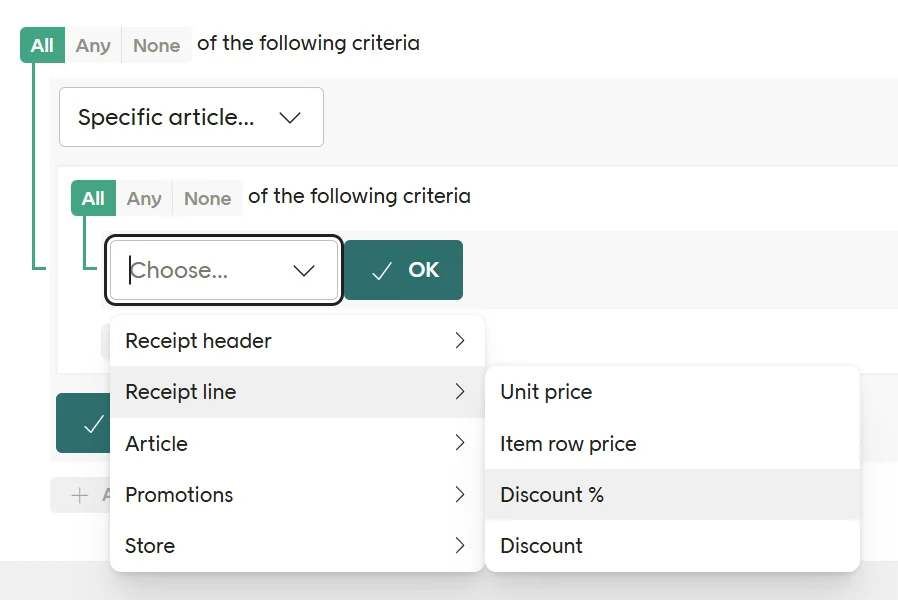
Aggregated row values as search parameter
decimal
required
Discount value in the local currency. Should always be negative. Searching for discounts in Customer Engagement is possible.
string
required
Type of discount.
string
A description.
usedRewardVouchers[row]
string
The unique ID number of the reward voucher to be redeemed when saving the transaction.
usedPromotions[row]
string
The ID for the main promotion. Can be used to link the purchase to a promotion.
string
The ID for the “instance” of the promotion assigned to a contact.
Don’t confuse the
Voyado recommends you use
Don’t confuse the
couponId (for an individual contact) with the promotionId (the “template” used).Voyado recommends you use
couponId over promotionId if possible, to avoid ambiguity in matching.Validations
discounts.valueshould always be negative- A return should have
item.type“RETURN” and thequantityshould be negative - A purchase should have
item.type“PURCHASE” and thequantityshould be positive - A
quantityshould never be 0 - Sum of all
paymentMethodsshould equaltotalGrossPrice - Sum of all
grossPaidPriceshould equaltotalGrossPrice - The
taxAmountshould equalgrossPaidPrice-grossPaidPrice/ (1 +taxPercent/ 100). The rounding error precision of this validation is by default 0.01. This value can be configured in the Customer Engagement backend to other values, or also turned off completely.