

Multichannel promotions
A multichannel promotion is one that can be set up to be used in-store or online or both ways. These promotions can be assigned to a contact based on their previous purchases or on any other type of contact data or interaction. You can assign multichannel promotions to segments as well as to single contacts in Engage. For this reason they’re also known as personal offers. Multichannel promotions can be used:- In-store - Here the contact is identified at the POS and their active multichannel promotions are fetched from Engage and are ready to use in the checkout
- Online - Here the customer will also need to identify themselves at some point in the flow, either by logging in, or when they fill in their details at the checkout. Then all available multichannel promotions can be fetched from Engage and shown. How exactly this is done will depend on how the e-com has been set up.
Creating multichannel promotions
There are several ways to create and assign multichannel promotions when working with Engage. In this article the focus will be mostly on the Engage API but there are also these methods:Promotions via the Engage UI
Promotions via the Engage UI
Setting up a multichannel promotion in Engage
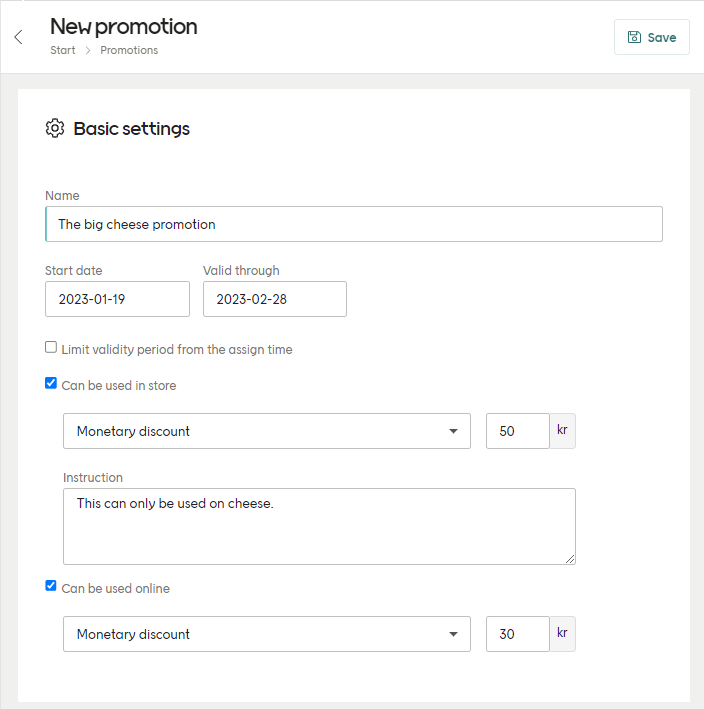
- Monetary discount
- Discount in percent
- Manual instruction (only for in-store POS)
- External promotion code
Learn about setting up multichannel promotions
Promotions via XML file import
Promotions via XML file import
Assigning promotions by XML file import are covered in this article:
Assigning promotions by XML file
Get promotions for contact
The API endpoint used to fetch all available promotions assigned to a contact is:-
contactId - The contact’s unique ID. If you have some other contact identifier, use this endpoint to get the
contactIdyou will need for this request. - redemptionChannelType - “ECOM”, “POS” or “OTHER”. If left out, all promotions are returned.
See example request
See example request
See example response
See example response
string
This identifies a specific “instance” of the promotion that was created from the “template” that was identified by
promotionId. The id value is unique to that contact and is the one used when redeeming this promotion.string
This is the ID of the main promotion (the “template” this particular promotion was created from). Many customers can have the same value for this, since it just refers to the main promotion. This CAN’T be used to redeem a promotion.
string
This value exists when the promotion has been created over the API. If the promotion was created manually in the Engage UI, this is null. It is not important when redeeming the promotion.
Redemption channels
When getting a contact’s promotion data, you’ll get back something like this:redemptionChannels object in the response specifies if a promotion is a percentage, a monetary amount to be withdrawn from the total amount of the transaction, or an external discount code that refers to a price rule in your platform.
See redemption channels object
See redemption channels object
redemptionChannels object:
- type - Which channel the promotion applies to.
- valueType - Which type of discount we want to assign (percentage, monetary or external code).
- value - The percentage, monetary amount or external code referring to the external price rule. With a monetary discount we also expose the group currency set in Engage for that client.
- instruction - An instruction that can be used, for example, to give some information to store staff regarding the promotion.
redemptionChannels examples:
Example: POS promotion with percentage discount
Example: POS promotion with percentage discount
Example: E-com promotion with external discount code
Example: E-com promotion with external discount code
Example: POS promotion with monetary discount
Example: POS promotion with monetary discount
Assign a promotion
Multichannel promotions, as mentioned, can be assigned to contacts in these ways:- Over the Engage API
- Manually in the Engage UI
- Though an XML file import
- 400: InvalidContactId, InvalidPromotionId
- 404: ContactNotFound, PromotionNotFound
Redeem a promotion
As soon as a promotion is used in a purchase, it must be redeemed in Engage so it can’t be used again. To do this you’ll need to know:- the promotion’s unique assignment ID
- the redemption channel, either “POS” or “ECOM”
1
Call the /redeem endpoint
Redeem the promotion with a call to this endpoint, adding the assignment ID in the path:In the request body, add the redemption channel:
2
Add promotion ID to /receipts call
As with every purchase, you will also call this endpoint with the full receipt information:Here you will add the assignment ID of the promotion used to the
usedPromotions block in the body of the query:/receipts endpoint but not /redeem, the promotion will still be redeemed, but often after a delay, bringing the risk that it could be used again.
If you call /redeem but miss to add the promotion assignment ID to the /receipts call, the system will not know which transaction to connect the redeemed promotion to. It will try to work it out based on the timestamp, checking for transactions within ±5 minutes of the redemption.
So you should always do both of these things whenever a promotion is used in a purchase.
Redemption response codes
If the request has been successful, you’ll get a HTTP 200 OK response. Otherwise you’ll get one of these:- 400: NotAValidRedemptionChannel, InvalidPromotionIdNoData
- 404: PromotionNotFound, PromotionNotAssociatedWithContact
- 409: PromotionNotValidForRedemptionChannel, PromotionAlreadyRedeemed, PromotionAlreadyRedeemed
- 504: GatewayTimeout
Create a promotion
Creation of a multichannel promotion can be done in three ways:- Over the Engage API
- Manually in the Engage UI
- Though an XML file import
- By giving a start date and a validity time
- By giving a start date and an end date
Creating promotion with start date and validity time
Creating promotion with start date and validity time
Here is what such a request looks like:Here is a successful response, containing the promotion’s ID:
Creating promotion with start date and end date
Creating promotion with start date and end date
Here is what such a request looks like:Here is a successful response, containing the promotion’s ID:The maximum value for end date is “9999-12-30”.
- 400: BadRequest
- 500: Error
Update a promotion
You can update (alter) a multichannel promotions over the Engage API. You can update the entire promotion or only its validity. Each method uses a different API endpoint:Updating the entire promotion
Updating the entire promotion
To update the entire multichannel promotion, used this endpoint:Send a payload in the same format as when you created the promotion, including your updates:
Updating the promotion's validity
Updating the promotion's validity
To update just the duration of an existing multichannel promotion, send a PUT to this endpoint:With a payload formatted like this:
Delete a promotion
You can delete a promotion using its Engage ID or its external ID (assuming an external ID was used when creating the promotion).Delete a promotion using its Engage ID
Delete a promotion using its Engage ID
To delete a multichannel promotion using the ID, use this endpoint:The
id value here is the Engage ID (“31bc4f89-6e71-4086-8627-af8f01073331” or similar).Delete a promotion using its external ID
Delete a promotion using its external ID
To delete a multichannel promotion using the external ID, use this endpoint with
externalId as the query parameter: